Your Change might be a new service
We Prototype Change®
We prototype Change with your people and leave a Change Muscle behind.
Most organizations don’t lack strategy. They struggle to make it real before they scale it.
Proof — VIB, Association of International Banks in Germany
“Prototyping changed how we work, not just what we offer. It gave us both the confidence and the capability to keep developing on our own.”
— Dr. Andreas Prechtel, Managing Director, VIB
In six months, VIB prototyped five new services with its members. Two are now live, two launch in 2027, and the team runs the capability itself.
The wider context
We’re not alone in seeing this — the numbers behind why prototyping works:
Change succeeds when people help make it real, not just receive it.
How we work
We Prototype Change
We build the smallest real version and test it with the people who’ll live it.
So it sticks
Because they help build it, they own it — so the Change sticks instead of stalling.
Change Muscle
Repeat it, and the standing ability to keep changing on your own stays behind.
Services
Wherever you are — starting, scaling or sustaining.
The team
We’re ChangeUp Global — a team that’s led change from the inside.



Services
One size fits one.
Every engagement is built around your problem — never a cut-and-paste solution. What stays constant is the method: we prototype the Change, with your team.

Inspire Change
Make a new direction real enough to believe in.
- When
- A team is stuck or sceptical.
- Together
- We build and test small, real versions with your people and customers.
- You leave with
- Tested concepts, real insight, and a team that wants to build it.
Enable Change
Turn an agreed ambition into a way of working.
- When
- The goal’s agreed; the “how” isn’t.
- Together
- We build a working pilot and shape it into a method your teams own.
- You leave with
- A repeatable way of working, trained change agents, and a roadmap.
Sustain Change
Make Change a habit, not a one-off project.
- When
- You want it to outlast the project.
- Together
- We turn prototyping into a routine, then step back.
- You leave with
- A lasting habit, internal coaches, and a Change Muscle.
Not sure which fits? Most engagements start the same way: one Change, and a conversation. Let’s find the first thing worth prototyping.
Our approach
Build small. Test with people. Learn. Adapt. Repeat.
One loop, applied to almost anything — the way Change gets real before it scales.
How we work
We prototype Change.
A new service, operating model or way of working — we don’t hand you a finished plan. We build the smallest real version with your people, test it for real, and scale what proves out.

Why it works
Re:Solve — how we put it into practice
Prototyping is the engine. Re:Solve is the structure we run it inside — tap a step.
We dig past the brief to the real problem, talking to the people and customers it affects, so we solve the right thing.
What you keep — Change Muscle
A good engagement leaves more than a solution. Done as a routine, prototyping builds Change Muscle: your organization’s standing ability to keep changing on its own. It grows through use and compounds with every Change — and it’s the outcome we care about most.
Our work
Change with a body
before it has a rollout.
Different industries, different scales — the same pattern: something made real, and tested with the people who’d live it, before anyone tried to execute it.
Featured case study
VIB — From representing members to building with them
How an association of international banks prototyped its way into a new mission.
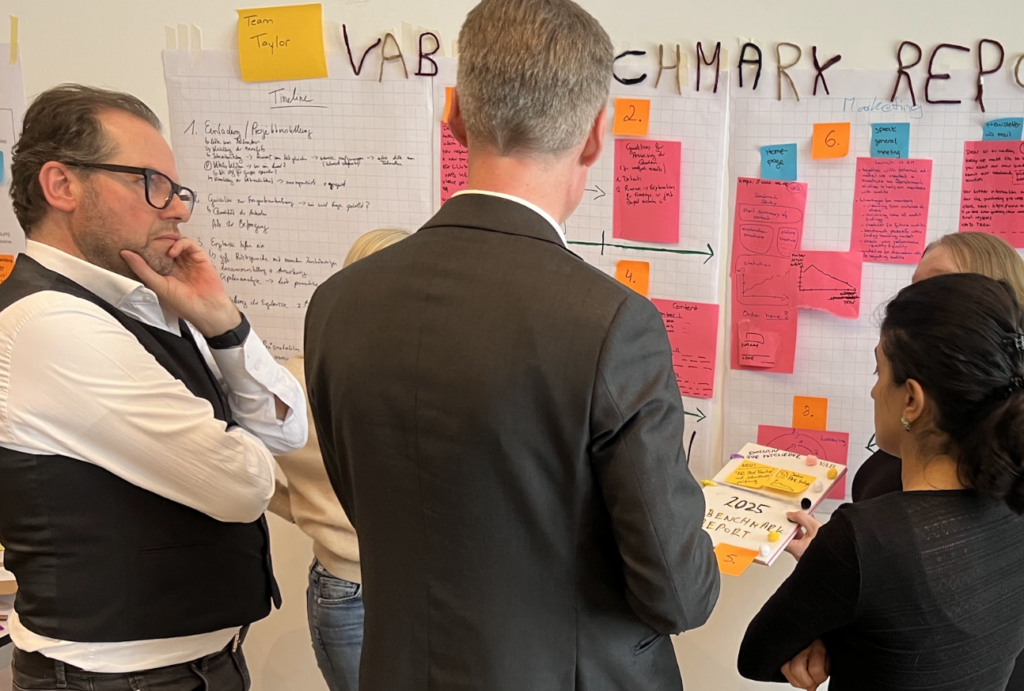
Before
In 2025, VIB — the Association of International Banks in Germany — set a bolder ambition: to actively develop new services for its members, not just represent them. None of it could be settled on paper. This was the kind of Change where the right answer has to be discovered, not predicted.
Prototyping
So rather than write a strategy and roll it out, we prototyped. Over six months we built the smallest real version of each idea and put it in front of members — something they could use and react to. Their responses, including the unwelcome ones, reshaped each concept within weeks.
After
Two services are now live (the VIB Expert Panel and VIB Connect), two more launch in 2027, and one was deliberately stopped when its prototype disproved its assumptions — a success in itself. The lasting result wasn’t the services. It was the capability: VIB now runs its own development routine, funded by a new revenue stream. VIB had built Change Muscle.
More of our work
Different industries, different scales — the same pattern underneath. A few more we keep coming back to.

Enabling Global Scale
A global firm with brilliant regional businesses, turning parallel effort into one shared global engine.

COVID drives Virtual Collaboration
Banking and tech leaders prototyping financial resilience for small business, in three weeks across seven time zones.

Product Innovation
Seven prototypes for the SME market — built with the customers who’d use them in the room.

Brand Activation
A non-profit reconnecting with its community — rebuilt by its own board in a single day, from real evidence.

Re-envisioning Community Engagement
A Parkinson’s support community finds the newly diagnosed people it was missing.

Branding a Moving Target
A start-up whose growth outran its brand — closed in pieces, not one big reveal.

Building an Innovation Practice
A profitable software firm shifting to customer-driven development, by letting people experience it first.

Defining a Problem Space
Competing asset managers openly define a shared data problem worth solving together.

Turning Vision to Value
A digital B2B experience made real in two markets, then pulled across 15+ by the ones watching.

Building a Design Thinking Practice
From a successful pilot to a firm-wide capability, carried by 30 change agents who’d lived it.
Ten we keep coming back to. Click any to read the full story.
Enabling Global Scale · Financial services · Global
Connecting regional intelligence into one global engine
A global firm with brilliant regional businesses, each solving the same problems independently, with no way to share what worked.
Before
Brilliant regional businesses, each solving the same problems in parallel, with their own products, brands and budgets. One region’s breakthrough never reached the others. Everyone agreed more collaboration would help, and had been agreeing for years. Agreement wasn’t the bottleneck; a structure for actually doing it was.
Prototyping
Rather than write a global operating model on paper, we ran one. We brought cross-functional regional leaders together to write a shared mission in their own words, then made collaboration real through a recurring forum: bimonthly 90-minute sessions and an annual five-day event, hosted somewhere different each year. Each session produced something usable. The forum wasn’t a meeting about the new way of working; it was the new way of working, in working form.
After
Working globally stopped feeling like political theatre and became the faster way to solve a problem. Solutions built in one region showed up in others, redundant investment dropped, and cross-regional teams formed without a reorg. The shift that mattered most: people started reaching across regions instinctively, because they’d learned it worked.
Why it matters
A global model written on paper is an argument. A global model you run is a habit.
Virtual Collaboration · Banking & technology · 7 time zones
Prototyping financial resilience for small business
Senior banking and technology leaders with real expertise, and no clear way to get it to the small businesses collapsing around them in lockdown.
Before
Spring 2020. Small businesses were collapsing in real time, and the people best placed to help were stuck at home on tools they barely knew, with no way to reach them. The ideas and the will existed. What didn’t was a way to turn a Zoom call into something a small business owner could actually use.
Prototyping
With banking technology partner Temenos, we prototyped what most organizations were still only talking about: fast, virtual, cross-company design work. Twenty-five experts, seven time zones, eight 90-minute sessions on Zoom and Mural — they learned the tools by using them. They interviewed small business owners across 12 industries to ground the work in what was actually happening. Two regional teams generated 150+ ideas and built two solution concepts.
After
Most organizations had spent a decade trying to build the conditions for this kind of collaboration. It happened here in three weeks, by volunteers, during a pandemic. Two concepts ready to plug into existing platforms, a confirmed pattern across both continents, and proof of something bigger: you don’t need a perfect setup to do meaningful cross-company work. You need a small container and a real problem.
Why it matters
Building it small first wasn’t a compromise. It was the only way in.
Product Innovation · Banking software · SME market
Seven prototypes for a market the company knew it should serve
A banking software company that could see a growth opportunity in SMEs, but couldn’t agree what to build, or how to build it fast enough to matter.
Before
They knew the opportunity and had the market research for months. What they couldn’t agree on was what to do with it: which problems mattered most, which solutions would land, how to move fast enough. The internal debate was rich on hypotheses and thin on evidence.
Prototyping
We prototyped two things at once: a set of new products, and a new way to develop them. For the first time, the people who’d use the products were in the room while they were built. Sixty-four people — banking leaders, technologists, and small business owners — working a structured design-thinking process over two days. Customers interviewed live; ideas tested for desirability, viability and feasibility as they emerged. Everything designed to keep the group out of slide mode and in build mode.
After
Forty-five customer interviews, 200+ ideas, seven prototyped concepts each with a marketing strategy and lean business plan — one became a new digital banking product for the SME segment. But the deeper change was how the firm and its clients saw each other: not vendor and buyer, but partners who build together.
Why it matters
The product was the visible output. The relationship was the lasting one.
Brand Activation · Non-profit · Lynn, MA
A non-profit reconnects with the community it serves
A community arts non-profit doing good work, but quietly losing its connection to the people it existed to serve.
Before
You can run great programs and still have your community keep its distance. The board could feel the gap. They’d talked about it before, with good intentions, but the conversation kept circling the same assumptions, and nobody in the room was the community. What was missing wasn’t another discussion about the brand. It was direct contact with the people the brand was meant to serve.
Prototyping
Instead of a traditional brand-strategy process, we designed an intervention that helped the board listen before deciding. In a one-day retreat, board members ran coached empathy interviews with local residents, business owners, police officers, civic leaders, and the mayor. Not everything they heard was comfortable, and that mattered. Then they worked directly from what they’d learned: shared problem statements, a SWOT, an elevator pitch, the first draft of a manifesto. Their own words, built together in the room.
After
The brand wasn’t announced. It was rebuilt by the people who lead it, in a single day, from real evidence instead of internal assumption. They left with a clearer understanding of the community, language they could use the next morning, and a direction that finally felt like theirs, because this time the community had been in the room.
Why it matters
You can’t rebrand your way back to a community you’ve lost touch with. You have to put them in the room.
Community Engagement · Non-profit · Oxford, UK
A Parkinson’s support community finds the people it was missing
A U.K. non-profit run largely by people living with Parkinson’s, stretched thin, and struggling to reach the newly diagnosed.
Before
Oxford Parkinson’s is run mostly by people who live with Parkinson’s themselves, committed and already stretched beyond what the work required. They knew their resources weren’t reaching the newly diagnosed, especially in less-resourced communities, and lockdown made those people harder to find. The board was running on goodwill and exhaustion; discussion was running ahead of insight.
Prototyping
We prototyped a different way for the board to lead: from evidence, not instinct. Nine 90-minute virtual sessions across eight weeks, nobody leaving their living room. We prepared and supported them to interview people living with Parkinson’s, carers, physicians and providers. The patterns became a defined problem area, 165 ideas, and six concepts. Two were prototyped, tested with the community, and put into action; four more became a clear roadmap.
After
A leadership team came in exhausted and left energised, not from a pep talk but from hearing directly from the people they exist to serve. Two solutions live, a roadmap for four more, and a board decision in their own words: “embed the design-thinking way of working in everything we do.”
Why it matters
They didn’t adopt the method because we recommended it. They adopted it because it plainly beat what the usual conversation produced.
Brand & Product · Social media start-up · Boston
A start-up’s growth catches up with its brand
A social media start-up racing to ship its MVP, with a product that was ready and a brand that wasn’t.
Before
The product had a spec and a launch date. What it didn’t have was a brand that matched what it actually was, and the visuals already going out were actively misleading new users about what the app did. The brand the founders carried in their heads hadn’t made it onto the screen, and time was running out.
Prototyping
We didn’t hand them a brand book. We treated each session as a small prototype: ship something, see how it lands, iterate. In short online sessions we helped them articulate their why, how and what, then see the app through a user’s eyes. Each iteration produced something tangible — a sharper logo direction, clearer messaging, a UX principle that made a hard decision easy. Nothing waited for the perfect version of itself.
After
A brand that finally matched the product, because it was built and tested in pieces, not announced in one go. A user-centred identity, guidelines future hires and developers could actually use, and UX maps that gave development and marketing a shared language. The founders ended up with a brand they’d made, not one designed for them, so they could explain it, defend it, and build on it.
Why it matters
A brand built in pieces, with the makers, is one they can keep building without asking permission.
Innovation Practice · Banking software
Shifting a successful firm toward customer-driven development
A profitable banking software firm that could see the gap between where it was and where the market was going, and kept finding reasons not to close it.
Before
The hardest place to start a transformation is from success. Clients trusted them but called them traditional; digital products were slow to land. A new digital business needed to grow, and a new way of working with it. But the firm was profitable enough that the case for changing anything was always harder to make than the case for leaving it alone.
Prototyping
We didn’t propose a multi-year programme — nobody needed another one. With the firm’s digital leader, we prototyped the new way of working as a repeatable event people could experience before committing to it. Clients and associates side by side over one to two days, on real problems, with full event design down to the music. Each event was a self-contained experiment: if it worked, you ran another; if it didn’t, you found out fast.
After
You can’t mandate a new way of working. You let people experience it and trust what they feel to do the persuading. The firm left with a repeatable, customer-driven approach they could run themselves, a repositioning from solid vendor to strategic partner, and direct client insight feeding product and sales. And internal energy, from associates who’d now done the thing. Those people became the argument for continuing.
Why it matters
You don’t persuade a profitable firm to change with a memo. You let a few people feel the better way, and let them carry it.
Problem Definition · Asset management · UK
Competitors agree on a problem worth solving together
Asset and wealth managers each spending heavily to solve the same data problems in isolation, and a firm that wondered what would happen if someone finally named it.
Before
Across the U.K., asset and wealth managers were quietly spending fortunes building the same custom solutions to the same data problems, in isolation, year after year. Everyone suspected they had a shared problem. Nobody had ever put it on paper together, because nobody wanted to be first.
Prototyping
We prototyped something the industry had never done: competing firms openly defining a shared problem together. We built a hypothesis sharp enough to argue with, then tested it — three 90-minute virtual sessions bringing data-management experts from competing firms into the same room, with exercises designed to validate it or break it. We weren’t looking for consensus on a solution. We were looking for a shared, evidence-based definition of the problem. Much harder, much more useful.
After
Survey results that set a baseline, a categorised set of problematic data patterns, a data-entity map of who provides and consumes the data, and a shared problem definition owned by the people closest to the work, not written for them by a consultant. Plus a credible, evidence-based case for handing the next stage to the cross-industry bodies whose remit it actually is.
Why it matters
Sometimes the win is making sure the right people own the right problem. The only way to prove it belongs elsewhere is to do it small first.
Digital Transformation · Financial services · Europe
Making digital real in two countries, then watching the rest pull it toward themselves
A global provider with a clear vision for digital B2B relationships across Europe, and not nearly enough of what it would take to make it real across 15 markets.
Before
A clear vision, and not much else: no team to build it, no tech stack to support it, no delivery approach that could survive 15 markets. This is how most digital transformations end — the vision is good, the deck is great, the product never reaches a customer.
Prototyping
We didn’t roll the change out across 15 countries. We made it real in a few first. With the Head of Digital for Continental Europe, we put a six-month timebox around the work and made sure people could see what we were building, not just read about it. We built a proper cross-functional team, filled the capacity gaps, and kept scope tight — customer research drove the MVP, not internal politics. Seven workshops across five markets and three milestones with senior leadership kept everything transparent. The lead markets weren’t “pilots.” They were the change, in working form, that everyone else could see and learn from.
After
The other markets didn’t ask “what does this mean for us?” They asked “how do we do what they did?” New websites went live across 15+ markets on time, local teams got a toolkit they could use, customers got a personalised experience, and the business got a central/local operating model it could keep running. Digital became the number-one B2B priority for Continental Europe, not by declaration, but because the evidence was sitting in 15 markets, working.
Why it matters
Momentum from evidence people can see beats momentum from any announcement.
Capability Building · Financial services · Europe
From a successful pilot to a firm-wide capability
A European financial services firm that had proven design thinking worked in one place, and now had to make it real everywhere.
Before
The pilot worked; the decision to institutionalise it was easy. The execution was the hard part: no internal coaching capacity, no rollout plan, and the predictable resistance when a successful organisation is asked to change how it works without disrupting work in progress. Everyone wanted the outcome; nobody had time to lead the change.
Prototyping
We treated the rollout itself as the prototype. With firm leaders, we identified 30 internal change agents chosen for their reach and disposition, and ran an immersive three-day programme on the Stanford d.school bootcamp format, tailored to the firm’s real customer problems: short bursts of instruction, long stretches of hands-on team work, then individual coaching to bridge back to day jobs. Those 30 became a working pilot of how design thinking could land at scale inside this firm.
After
Thirty trained, energised change agents, each with first-hand stories about how customer insight changed a solution and a bias toward action shipped work faster. A Design Thinking centre of excellence to support the broader rollout, and a roadmap to take the capability across the firm. They didn’t just learn a method; they became the argument for it, in every team, long after we left.
Why it matters
You don’t scale a method with a mandate. You scale it with people who’ve already lived it.
Insights
What we’re learning
about Change.
Short reads on prototyping Change and building Change Muscle — and what it means for you.
What prototyping Change actually looks like
The smallest real version, tested with the people who’ll live it, and reshaped before it scales.
Read more →What LEGO Serious Play taught us about Change
An idea from a learning theory and a pile of bricks: people commit to what they build, not what they’re told.
Read more →Change fatigue, and how to build energy instead
People aren’t against Change — they’re tired of how it arrives. Why prototyping adds energy where rollouts drain it.
Read more →What Change Muscle is, and why it compounds
The rarer prize isn’t the outcome — it’s an organization that’s gotten better at changing.
Read more →The trade-off you don’t actually have to make
De-risking a Change and winning people over feel like opposites. Prototyping does both with the same move.
Read more →Why the most adaptable part controls the system
A principle from cybernetics: in a changing world, flexibility isn’t the opposite of control. It is control.
Read more →The research behind our approach →
Follow ChangeUp on LinkedIn for the Research Digest — every two weeks.
What prototyping Change actually looks like
The smallest real version, tested with the people who’ll live it.
“Prototype Change” can sound abstract. In practice it’s simple. Build a small, real version of Change. Put it in front of the people who’ll live it. Let what happens reshape it, then run it again.
Not a slide about a new way of working, but a working piece of it. At VIB, the Association of International Banks in Germany, that meant real, early versions of five new services, in front of members. Their responses, including the unwelcome ones, reshaped each concept within weeks. Two are now live. Two launch in 2027. One was stopped when its prototype disproved its assumptions, a success in itself, because VIB learned before it invested.
Here’s what makes it work. The people who’ll live the Change help build it, so they own it. Showing beats telling. And because the version is real, it’s genuinely allowed to change the plan. If the answer is decided in advance, it isn’t a prototype.
You don’t have to transform everything to start. Take one Change you’re about to make and build a small, real version of it. Real prototyping is real work. But the first step is small, and it teaches you more than another round of planning ever could.
That’s how we work at ChangeUp. If there’s a Change on your desk, let’s prototype it together.
What LEGO Serious Play taught us about Change
People commit to what they build, not what they’re told.
One of the most useful ideas in Change work didn’t come from a strategy firm. It came from a learning theory and a pile of bricks.
LEGO Serious Play® was created in the 1990s by Johan Roos and Bart Victor (2019), and it’s built on constructionism, the theory Seymour Papert developed at MIT (Papert, 1980). The idea is simple: people learn most deeply, and commit most fully, when they build something they can see, handle and share. Not when they’re told about it.
We build that principle into how we work. When we prototype Change with your team, we’re doing constructionism at organizational scale. Instead of describing a new way of working, we build a small, real version of it, and the people who’ll live it help shape it. Understanding and ownership form in the same motion.
That’s why our workshops don’t feel like a presentation. People build something real, test it, and push on it together, and they leave owning it.
If you want your next Change built with your people rather than announced to them, let’s talk.
Sources: Seymour Papert, Mindstorms (MIT, 1980); Johan Roos & Bart Victor, “How It All Began: The Origins of LEGO® Serious Play®,” IJMAR 5(4), 2019.
Change fatigue, and how to build energy instead
Why prototyping adds energy where rollouts drain it.
Most people aren’t against Change. They’re just tired of how it usually arrives: as a finished plan, announced, with a request to get on board. Do that often enough and you get Change fatigue. It’s part of why only 32% of leaders get their people to adopt change in a healthy way, and why trying to inspire change now works far less well than making it a routine (Gartner, 2025).
When we prototype a Change with you, the energy in the room is different. Two things drive it. Tangibility: a working version people can try, not just hear about, turns an audience into contributors. And playfulness: a deliberate kind of play that lowers the guard, so people bring curiosity instead of caution.
There’s a quieter reason too. Fatigue grows when Change is done to people, and eases when it’s done with them. Give people a hand in shaping the thing, and the initiative that might have worn them out starts to give energy back, because now it’s partly theirs.
If your people are worn out by Change, the answer usually isn’t another campaign. It’s a different first move — one they help build rather than brace for. It starts with a conversation.
Source: Gartner, “Leaders Today Must Routinize, Not Inspire, Change” (2025).
What Change Muscle is, and why it compounds
The capability that outlasts any single change.
Most transformation programmes deliver an outcome and move on. The rarer, more valuable prize is what they leave behind: an organization that has gotten better at changing. We call that Change Muscle, and building it is what we’re really there to do.
The first time a team prototypes a Change, it feels awkward. The second time, less so. By the fifth, it’s simply how the team works. What builds up isn’t a framework on a shelf. It’s a capability inside your people: the confidence to start before everything is certain, the habit of testing with real users, the muscle memory of learning quickly and adjusting.
Like any muscle, it grows through use. Gartner finds the same pattern: making Change a routine is three times more effective than trying to inspire it, and what leaders should build are “change reflexes,” skills practised until they’re second nature (Gartner, 2025). So we don’t just hand over the Change. We run it with your team, so the capability stays when we leave.
And it compounds. Each Change your team prototypes makes the next one cheaper and less tiring. Over time the value becomes your organization’s growing ability to keep changing.
The best time to start is your next Change. Let’s prototype it together.
Source: Gartner, “Leaders Today Must Routinize, Not Inspire, Change” (2025).
The trade-off you don’t actually have to make
Why reducing risk and winning people over are the same move.
Every leader knows the feeling. You want to move fast and bring people with you, but the two seem to pull against each other. Play it safe and you lose the energy. Chase the energy and you feel like you’re loosening your grip on the risk. So it seems you have to pick one.
Prototyping quietly dissolves that choice, because it does both at once. Testing Change on a small, real scale is how you keep it safe: you find the weak assumptions before real money goes in. That’s the rigor.
And because the people who’ll live the Change help build that small version, they come to own it. Involving people in shaping a Change, rather than only communicating it, raises the odds it succeeds from 34% to 58% (Gartner, 2023). That’s the buy-in.
Same activity, both results. Prototyping gives you a safer Change and a committed team together, because they come from the same work.
If a Change on your desk feels like a choice between playing it safe and bringing people with you, it may not be. Let’s prototype it, and get both.
Source: Gartner (2023).
Why the most adaptable part controls the system
The Law of Requisite Variety, and what it says about Change.
There’s a principle from cybernetics — the study of how systems steer themselves — called the Law of Requisite Variety. It says that in any system, the part with the most behavioural flexibility, the most ways to respond, ends up exerting the most control over the outcome. Not the biggest part, or the strongest. The most adaptable one.
It’s a sharp lens for Change. An organization facing an uncertain market can’t control that market. What it can control is its own range of responses — how many moves it can make, and how fast it can try them. The wider that range, the more say it has over where it ends up. So in a changing system, flexibility isn’t the opposite of control. Flexibility is control.
Fixed goal, fluid method
This is why we hold the goal fixed and keep the methods fluid. The target stays clear; the route to it stays open to tools, ideas and behaviours we didn’t plan on. A plan with a single path has low variety — the moment that path is blocked, it’s stuck. A prototype has high variety by design: it’s built to change course the instant reality asks it to.
It starts with people, not the org chart
Real adaptability doesn’t begin in structure. It begins in people — in the capacity to solve problems creatively and stay steady when a plan has to change. You can’t restructure your way to it. You build it the way you build any capability: through use. That’s a Change Muscle, and it’s also what gives an organization its requisite variety.
So design Change to be shaped
Flexible control systems, in everything from broadcast to industrial automation, share one trait: they let people shape the environment rather than be constrained by it. We build Change the same way — modular and adjustable, not fixed and handed down. The more your people can adapt how a Change works, the more control they keep over how it lands.
The future won’t hold still, so the aim isn’t to predict it. It’s to widen your range of responses until you can meet whatever it brings. Let’s build that capacity together.
Based on W. Ross Ashby’s Law of Requisite Variety (An Introduction to Cybernetics, 1956).
The research
The evidence behind prototyping Change.
Three numbers shape how we work. Here’s what each one means, and where it comes from.
We don’t just assert that prototyping works. Three strands of research converge on the same conclusion: transformation rarely fails for lack of strategy or money — it fails because Change is never made real before it scales. Here’s the evidence, number by number.
70% — transformations still fall short
Three separate firms, three separate datasets, the same answer. McKinsey and BCG both put the share of transformations that fail to meet their objectives at around 70%, and Bain’s study of 24,000 initiatives puts it higher still — 88% fall short of their original ambitions. What’s striking isn’t just the size of the number, it’s how stubborn it is: it has barely moved in two decades, despite better tools, more data and ever more sophisticated frameworks.
The reason isn’t strategy, and it isn’t talent. It’s execution. Change gets designed on paper, approved in a room, and handed to the people expected to live it — who then discover what actually works, often too late to change course cheaply. The distance between “looks right on a slide” and “works in reality” is where most of the value leaks out.
What it means — more planning doesn’t move the odds. A different first move does: making the Change real, and small, before you scale it.
Sources: McKinsey (2022); BCG (2024); Bain (2024).
34% → 58% — involving people nearly doubles the odds
When people help shape a Change, rather than just receive communications about it, Gartner finds the likelihood of success rises from 34% to 58%. Participation builds ownership, and ownership is what makes Change stick. It also explains a counterintuitive finding we see constantly in the field: the more you communicate a Change, the more resistance you can create. People commit to what they help build, not to what they’re told.
The context makes this urgent. The average employee went from about two major changes a year in 2016 to ten in 2022, and willingness to support change fell from 74% to 43% over the same period. Change fatigue is real and growing — and louder messaging makes it worse, not better. Gartner’s more recent work points the same way: only 32% of leaders get their people to adopt change in a healthy way, and making change a routine proves roughly three times more effective than trying to inspire it.
What it means — the lever isn’t communication, it’s participation. Build Change with the people who’ll live it, and make it a routine rather than a one-off.
Sources: Gartner (2023); Gartner change-fatigue research (reported in Harvard Business Review, 2023); Gartner, “Leaders Today Must Routinize, Not Inspire, Change” (2025).
$3.4T — the money riding on getting Change right
Global spending on transformation is projected to reach roughly $3.4 trillion in 2026. Organizations are investing more than ever — and most of that investment still underdelivers. Put the spend next to the ~70% failure rate and the scale of the waste becomes hard to ignore.
The gap isn’t budget. It’s approach. Pouring more money into a plan that was never tested in reality doesn’t change the odds; it only raises the stakes of getting it wrong. The organizations that beat the average don’t spend more — they make Change real with the people who’ll live it before they scale, so the money follows what’s been proven rather than what’s been assumed.
What it means — scale isn’t the problem. The advantage goes to whoever learns fastest and cheapest, with their people — not whoever spends the most.
Sources: IDC (2026); McKinsey.
The through-line
Read together, the numbers tell one story. Transformation doesn’t usually fail because the strategy was wrong or the budget too small. It fails because the Change is never made real before it’s scaled, and because the people who have to live it had no hand in shaping it. Prototyping is how you close that gap — and, done as a routine, how you build the capability to keep closing it. That capability is what we call Change Muscle.
About ChangeUp
Built by people who’ve led
Change from the inside.
A boutique consultancy that knows what it takes to make Change stick.

Who we are
A boutique Change consultancy — hands-on operators who’ve led transformation from inside large organizations, 50+ years combined across the U.S. and Europe. We don’t hand you a deck and leave; we build the Change with your people and help you keep going once we’re gone.
Why we founded ChangeUp
We spent decades leading innovation inside big financial institutions, including Fidelity — and kept watching good strategies stall the moment they met the people meant to live them. Not because the thinking was wrong, but because no one had shaped it with them, or made it real enough to test first.
So in 2018 we left to do the opposite: build the Change small and real, with those people, and let what we learn reshape it before it scales.
Meet the team
Three founders, three strengths — all pointed at the same thing: Change that sticks.
Julia Cichowski
Experience. 30+ years transforming complex financial institutions, including innovation programs at Fidelity.
Strength. Co-creation — designing Change with the people who’ll live it. She also serves on the boards of the Oceanic Research Group and Sea Save Foundation.
Helps clients. Build Change that lasts, because their own people helped make it.
LinkedIn →
Martin Schmidt-Sarno
Experience. 25+ years connecting business and technology on high-stakes transformations, mostly from inside the organization.
Strength. Bridging strategy and delivery across cultures and functions. He leads our European work, including VIB.
Helps clients. Turn a bold ambition into a working way of operating.
LinkedIn →
Christopher Whitlock
Experience. From illustrator to executive creative director; at Fidelity he helped scale design thinking across the enterprise.
Strength. Making the abstract tangible — giving an idea a form people can react to.
Helps clients. See and shape a Change before it’s built, so teams commit to it.
LinkedIn →Boston · Frankfurt — a global network working across Europe and the US.
What we believe
Collaboration over control. The best way to get it is to do it. We embrace the discomfort of trying something new — and we see Change as opportunity. Even if you don’t feel ready, start now.
At least 30% of our work is pro bono — causes we believe in, at no fee. For example, we helped Oxford Parkinson’s reach the newly diagnosed people it was missing.
Contact
Let’s prototype it together.
Have a Change on your desk? Tell us what you’re facing. It starts with a conversation.
Reach us
Where we are
Boston · Frankfurt
A global network working across Europe and the US.
Follow